
Last updated October 15, 2026
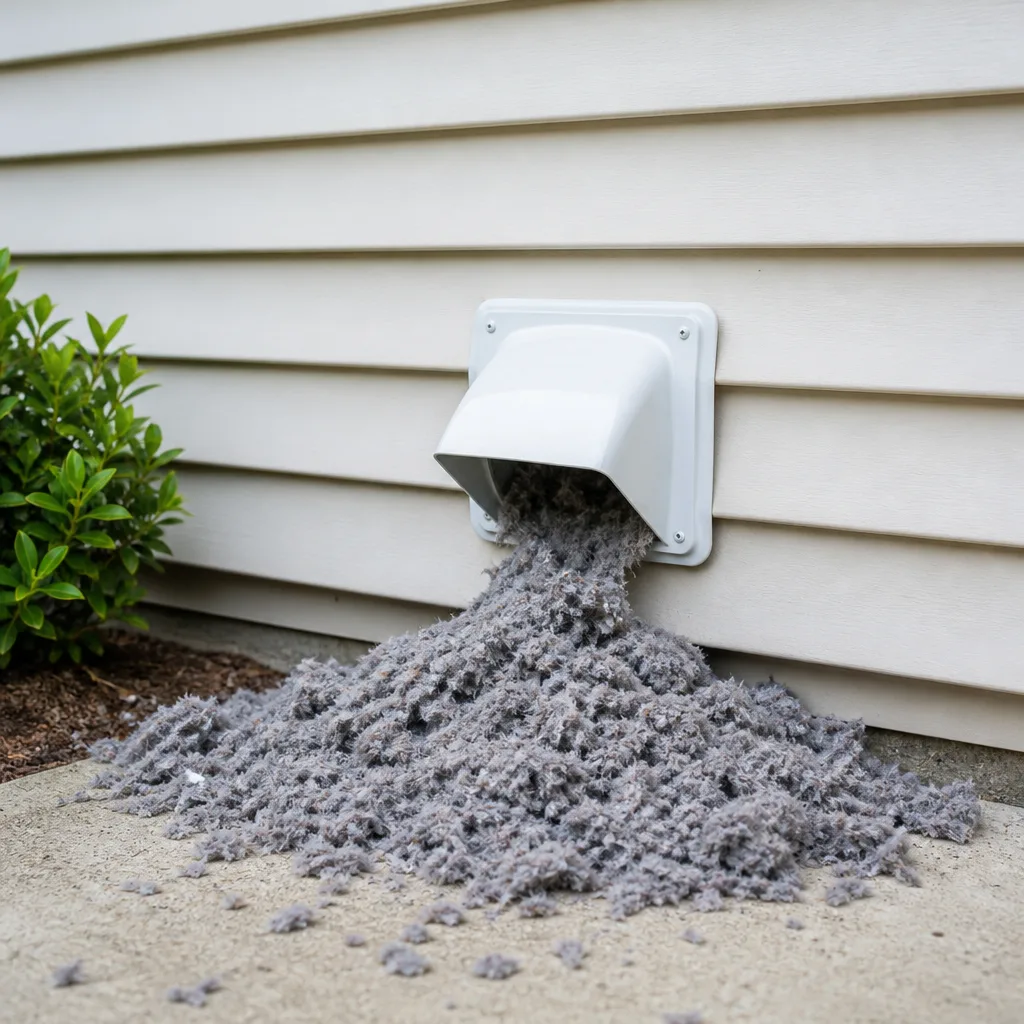 Dryer vent cleaning
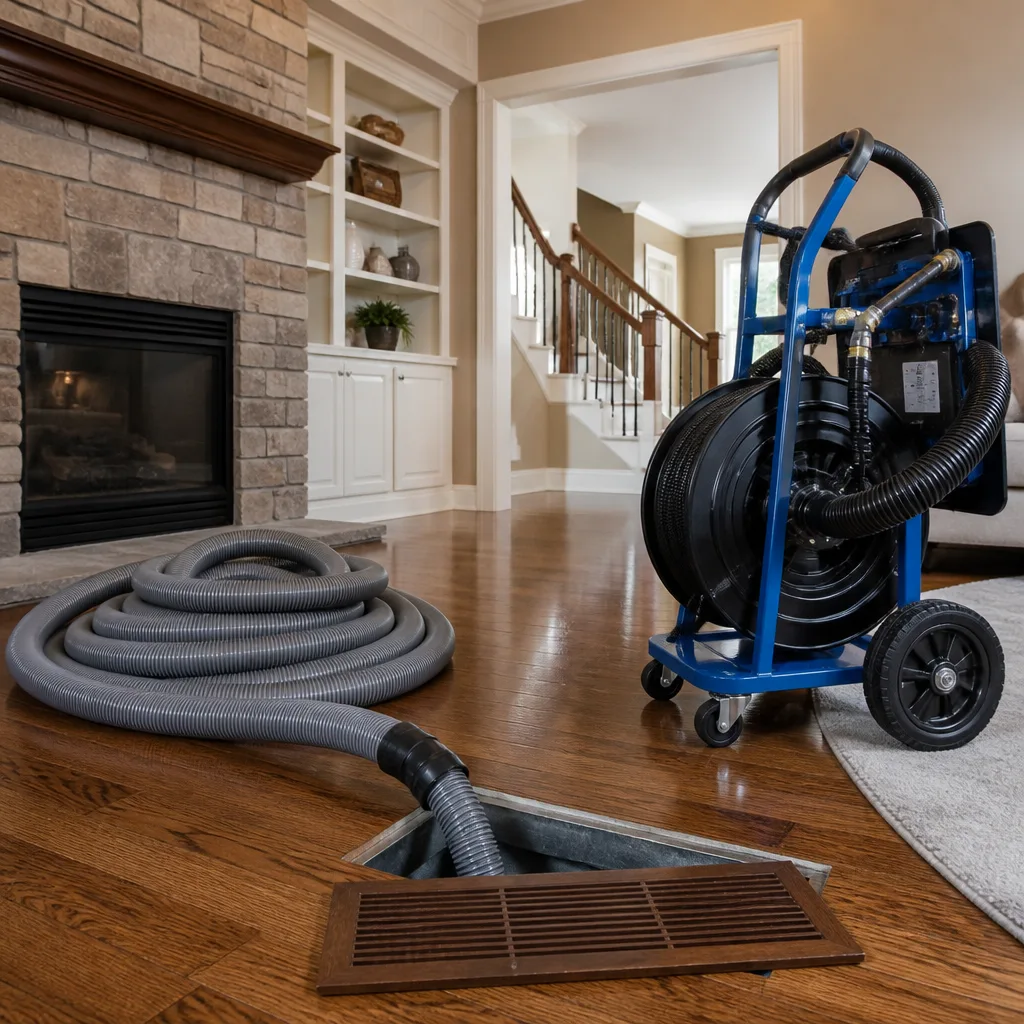 Whole-home duct cleaning
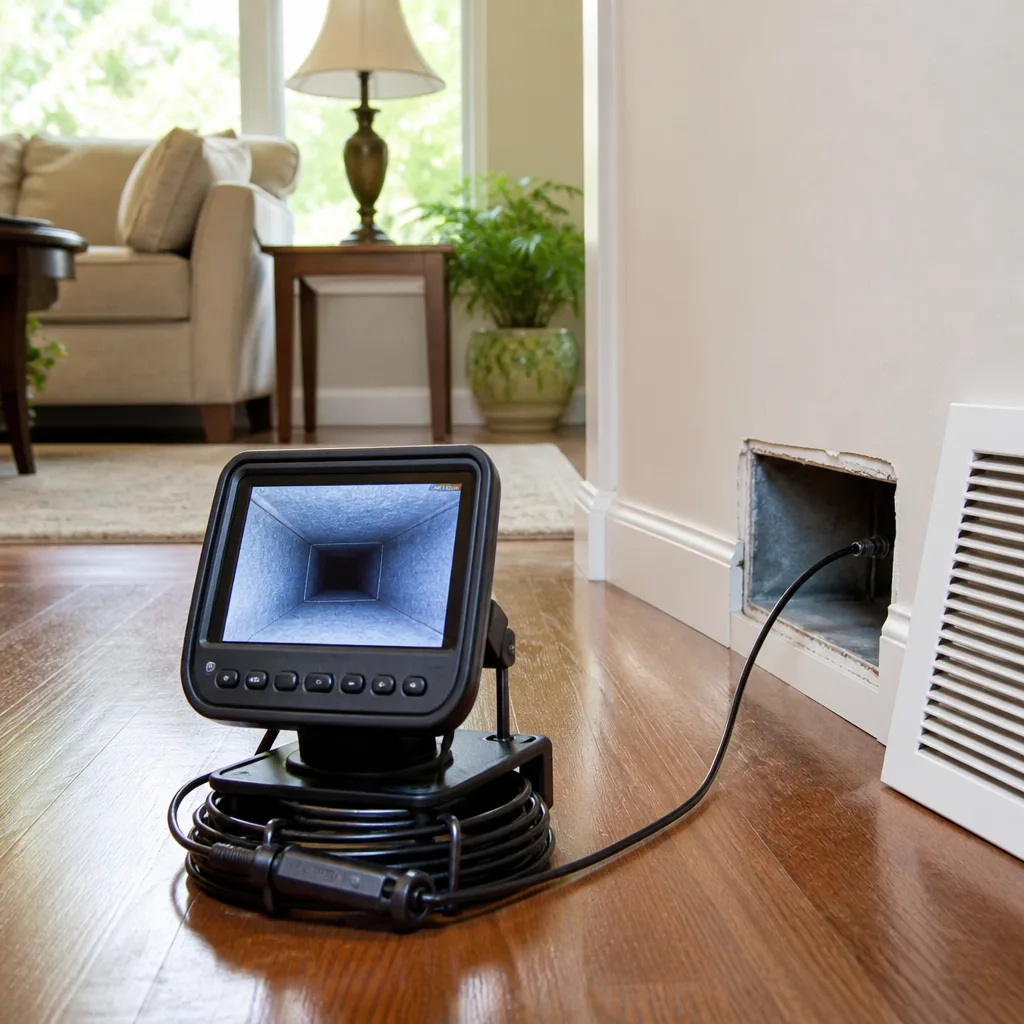 Camera inspection
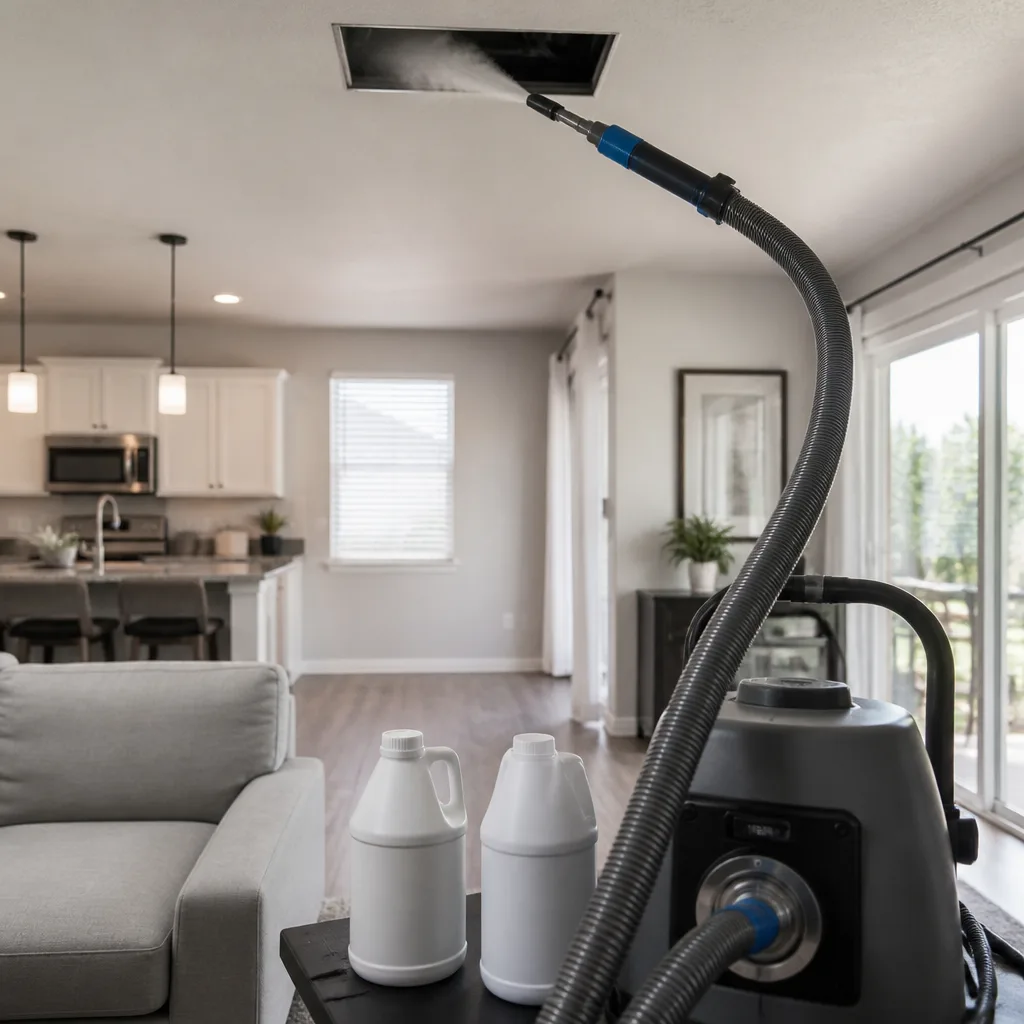 Sanitizing & deodorizing
Whole-system duct and dryer vent check with before-and-after photos - you see exactly what came out of your vents
That "$99 whole-house special" is a bait ad - the real number appears once they are in your hallway, or the "clean" is a shop-vac at the register. We photograph the inside of your ducts before and after instead.
Dryer Vent Cleaning Maintenance Checklist for Woodland Hills Homeowners
The U.S. Fire Administration attributes roughly 2,900 home dryer fires every year to lint buildup in vents, but that national figure flattens a critical local truth: in Woodland Hills, where summer temperatures routinely climb past 100 degrees and the air stays bone dry, dryers run longer cycles on hotter settings than they do in coastal neighborhoods. That means lint accumulates faster, stacks up sooner in long vent runs, and turns a routine chore into a time-sensitive fire risk. This guide gives you a month-by-month maintenance system built around the way Woodland Hills homes are actually constructed and the way valley heat actually changes how you dry clothes. You’ll learn which tasks you can safely handle yourself, which ones require a professional with a rotary brush kit, and how to know if your cleaning interval should be twelve months or six.
Styles & brands we work with
Quick Answer
Woodland Hills homeowners should clean the lint trap before every load, inspect the exterior vent flap monthly, and schedule professional Dryer Vent Cleaning every 6 to 12 months depending on vent run length and dryer usage. The most effective maintenance system combines a monthly 5-minute visual check with a professional cleaning that uses rotary brush agitation paired with HEPA-rated negative-pressure extraction. If your dryer takes more than one cycle to dry a normal load, the exterior flap isn’t fully opening, or you catch a brief burning smell, the vent needs attention now, not next season.
Table of Contents
- The Woodland Hills Month-by-Month Maintenance Checklist
- How Vent Run Length and Elbow Count Change Your Cleaning Interval
- Three Warning Signs Most Woodland Hills Homeowners Miss
- Why Foil Accordion Flex Duct Is a Problem in Older Woodland Hills Builds
- What You Can Do Yourself vs. What Needs a Rotary Brush Kit
- Cost and Time Benchmarks for Dryer Vent Cleaning in Woodland Hills
- How Valley Heat and Santa Ana Winds Change Your Maintenance Rhythm
- Common Mistakes to Avoid
- When to Call a Professional
- Frequently Asked Questions
- The Bottom Line
The Woodland Hills Month-by-Month Maintenance Checklist
Most dryer vent advice stops at “clean the lint trap,” which is about as useful as telling someone to check their oil and calling it a full car maintenance program. What you need is a calendar. Here’s the system we’ve developed after years of cleaning dryer vents in Woodland Hills homes, and it breaks down into what you do yourself and what you hire out. The homeowner tasks take five minutes or less. The professional task takes one visit.
Do This Yourself: Monthly and Per-Load Checks
- Before every load: Pull the lint screen, peel off the lint sheet, and run the screen under water. If water beads on the screen instead of passing through, fabric softener residue has built up and is blocking airflow. Scrub it with warm water and dish soap, then let it dry.
- First weekend of every month: Walk outside to the exterior vent flap. With the dryer running on air-only, the flap should be fully open and pumping air. If it’s hanging at half-mast or barely moving, airflow is restricted.
- First weekend of every month: Note how long a standard towel load takes. When that time creeps past one cycle and into two, write down the date. That’s your early warning that lint is building up inside the vent run.
- Every 90 days: Vacuum the lint trap housing with a narrow crevice tool. Lint falls past the trap and collects in the housing, where it becomes fuel.
Hire This Out: Professional Cleaning Cadence
- Homes with short, straight vent runs under 8 feet: Annual professional cleaning is usually adequate.
- Homes with vent runs over 8 feet or with two or more 90-degree elbows: Schedule professional cleaning every 6 months. The majority of Woodland Hills tract homes built in the 1970s through 1990s fall into this category because the laundry room sits in the middle of the house rather than against an exterior wall.
- Households with pets, large families, or frequent towel-heavy loads: Every 6 months regardless of vent configuration.
For the full professional service, see our breakdown of Dryer Vent Cleaning in Woodland Hills for what a complete job includes and how it’s priced.
How Vent Run Length and Elbow Count Change Your Cleaning Interval
Here’s the detail that most dryer vent guides completely skip, and it’s the one that matters most in Woodland Hills: the distance between your dryer and the outside wall, plus the number of bends in the pipe, directly controls how fast lint accumulates and how hard your dryer has to work. This isn’t a mild inconvenience. It’s the single biggest variable in whether your vent becomes a fire hazard in six months or twelve.
Every 90-degree elbow in a dryer vent system reduces airflow by roughly 20 to 25 percent in real-world installations. A dryer vent that starts behind the machine, runs up into an interior wall, elbows again into a ceiling chase, and exits through the roof might have three or four bends before it sees daylight. That system is building lint at a rate that makes once-a-year cleaning insufficient, full stop. In the tract homes common across Woodland Hills, especially the single-story and split-level layouts built between 1970 and 1995, we routinely see vent runs of 15 to 30 feet with multiple elbows. The manufacturer’s recommended maximum for most dryers is 25 feet total, and each elbow subtracts 5 feet from that budget. A 20-foot run with two elbows is effectively at the operating limit before you’ve added a single load of laundry.
When a vent run exceeds manufacturer spec, lint doesn’t just build up; it packs down in the bends. The first elbow after the dryer is almost always the worst. That’s where lint moving up from the machine hits a wall, slows down, and drops out of the airflow. In our experience cleaning dryer vents in Woodland Hills, the first elbow accounts for the majority of blockage in roughly 7 out of 10 problem vents we open up.
The practical takeaway: if you can trace your vent and see multiple bends or you know your laundry room sits in the center of the house, six months is your interval. This aligns with what we recommend on our Cardinal Air Duct Woodland Hills home page: cleaning is priced per system with a written quote before work starts, so adjusting to a twice-yearly cadence doesn’t require a physics degree, just a calendar.
Three Warning Signs Most Woodland Hills Homeowners Miss
Dryer vents rarely fail catastrophically without warning. They telegraph the problem for weeks or months, but the signals are subtle, and most homeowners have been trained to ignore them. These are the three we flag most often in Woodland Hills homes, and all three are easy to catch once you know what to look for.
1. Clothes Taking More Than One Cycle
The first sign of dryer vent blockage is not smoke or a burning smell. It’s time. When a standard load that used to dry in 45 minutes starts taking 70 or 80 or 90, that’s the vent telling you airflow has dropped below the threshold where the dryer can do its job efficiently. Many homeowners attribute this to an old dryer or heavy towels, but in the majority of homes we serve in Woodland Hills, it’s lint accumulation in the vent run. A dryer that needs two full cycles to dry a normal load is not slow; it’s starved for airflow. That heat and moisture are staying in the drum and in the vent, and heat plus trapped lint is how dryer fires start.
2. Exterior Vent Flap Not Fully Opening
Stand outside your home while the dryer runs. The exterior vent flap, the little plastic or metal door with slats or a hinged cover, should be pushed fully open by the force of the exhaust air. If it’s barely moving, fluttering weakly, or hanging completely closed, the dryer is struggling to push air through a system that’s partially clogged. We’ve seen homeowners in Woodland Hills with flaps sealed shut by years of layered lint on the inside face of the vent cap. The dryer still runs fine, for now, because dryers are stubborn machines designed to push against resistance. But resistance is the variable that turns long drying times into overheating, and overheating into a fire threat.
3. A Burning Smell That Disappears Quickly
A burning smell that flashes for a minute or two and then goes away is the warning sign most people rationalize. They smell it, then it disappears, and they decide it must have been something on the element. What’s happening, in most cases, is that lint in the early stages of heat degradation is being warmed by the dryer’s exhaust stream. The smell comes when the machine runs, then fades when the lint cools. This is not a one-time event. It’s a preview. Lint that has begun to smell when heated is on the path to ignition, and in the confined space of a 4-inch vent pipe, that transition can happen on a single hot day in Woodland Hills.
Why Foil Accordion Flex Duct Is a Problem in Older Woodland Hills Builds
If your home was built between 1970 and 1995, there’s a decent chance your dryer vent is made of foil accordion flex duct. That’s the silvery, ribbed, flexible tube that bends easily and costs a few dollars per foot at the hardware store. It was common practice for decades because it allowed builders to connect dryers to vents quickly and cheaply. But it has two things going against it, and in Woodland Hills, both matter.
First, the ribbed interior surface grabs lint. Dryer exhaust moving through a smooth pipe has a fighting chance of carrying most lint particles to the outside. But every ridge in accordion flex creates a pocket of turbulence where lint drops out and accumulates. Over time, that flex duct becomes a lint trap from the inside, with no accessible way to clean it thoroughly without professional equipment. Second, foil accordion duct burns. It is not rated as a fire-resistant material, and when lint inside ignites, the duct itself provides fuel. This is why current building code in most California jurisdictions prohibits foil accordion flex duct, and why we remove it whenever we find it during a Woodland Hills dryer vent cleaning.
The replacement is a rigid or semi-rigid metal duct, the type that holds its shape and has a smooth interior wall. It costs more per foot, but it resists crushing, doesn’t ripple to collect lint, and creates a continuous path for exhaust to leave the home. If you’re not sure what’s behind your dryer, pull the machine out and look. If you see silver ribs, the right move is to have the duct replaced at the same time as your next professional cleaning. We see this situation regularly across Woodland Hills and the surrounding valley, and it’s a straightforward job for a technician with the right materials on hand.
What You Can Do Yourself vs. What Needs a Rotary Brush Kit
There’s a line between routine maintenance and the work of a professional, and it’s drawn by both safety and equipment. On the homeowner side of the line: lint trap care, exterior flap inspection, machine-to-wall duct connection checks, and basic observation of how long cycles run. All of that is within your reach and takes minutes.
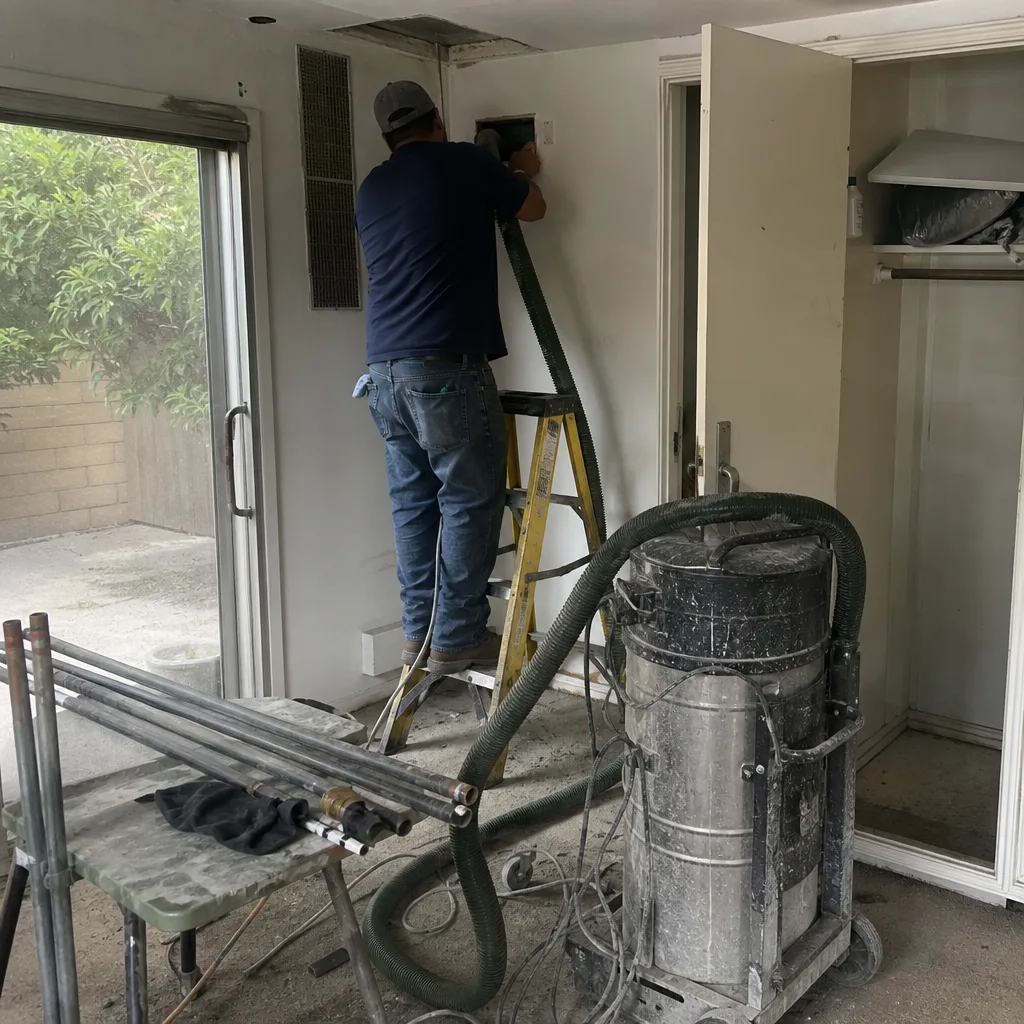
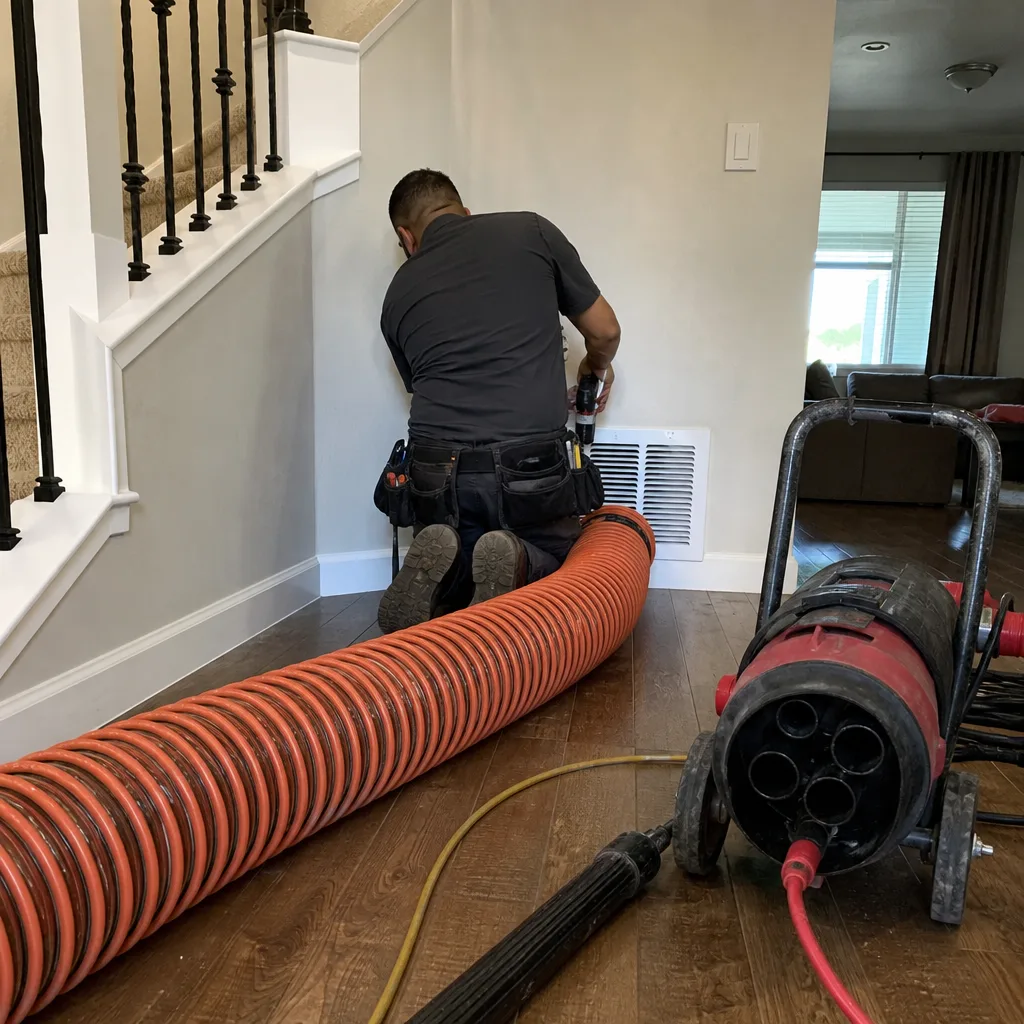
On the professional side of the line: anything inside the wall, ceiling, or floor cavity. A dryer vent is a closed system, and when lint builds up inside it, a vacuum or a lint brush from the outside will not reach it. That’s where we bring in rotary brush systems from Rotobrush, which spin a brush head through the full length of the vent to break packed lint off the interior walls, paired with a Nikro HEPA-rated vacuum running negative-pressure extraction. Negative-pressure means the loosened debris travels straight into the vacuum canister rather than back into your laundry room or living space. It’s the standard for a reason.
We also don’t recommend homeowners climb onto steep roofs to clear roof-terminating vent caps. Woodland Hills homes frequently route dryer vents through the roof, especially in two-story builds, and that’s a height and fall hazard that’s not worth the risk. The same logic applies to any vent run you can’t access from both ends. If your vent is long, if it has multiple bends, if it exits through the roof, or if you’re seeing any of the warning signs above, that’s a job for a professional with the right equipment. If you’re in the Woodland Hills area, our full Dryer Vent Cleaning in Woodland Hills page walks through exactly what we do and how it’s priced.
Cost and Time Benchmarks for Dryer Vent Cleaning in Woodland Hills
Price transparency in dryer vent cleaning is rare, which is why we publish ours. Most standard dryer vent cleanings for a typical Woodland Hills single-family home run between $120 and $250, depending on vent run length, the number of elbows, and the level of blockage. The job typically takes 45 minutes to 90 minutes from arrival to finish. If the technician quotes less than about $80, read that quote carefully; in many cases the teaser price covers the first 5 or 10 feet and every additional foot, elbow, or visit generates charges you didn’t see coming. This is the bait-and-switch model that gives the industry a bad name, and we recommend walking away from it.
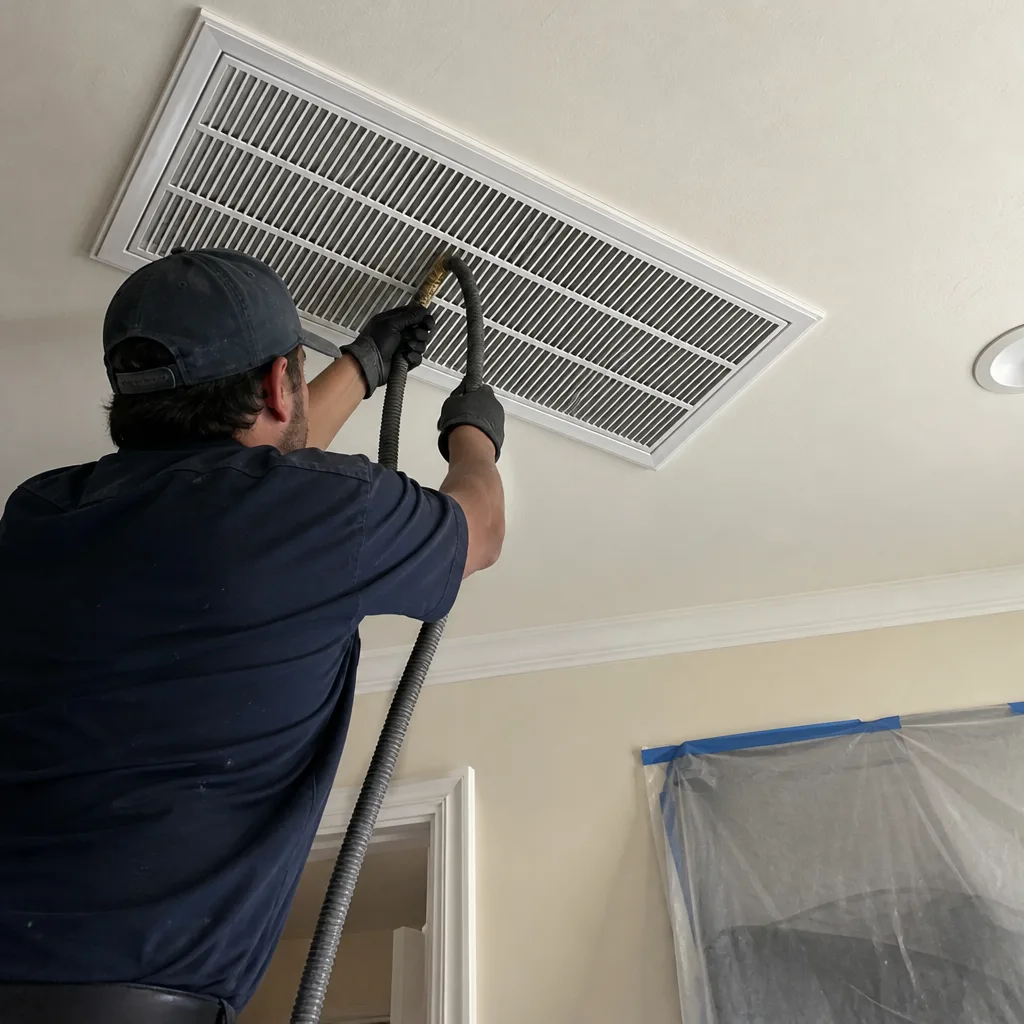
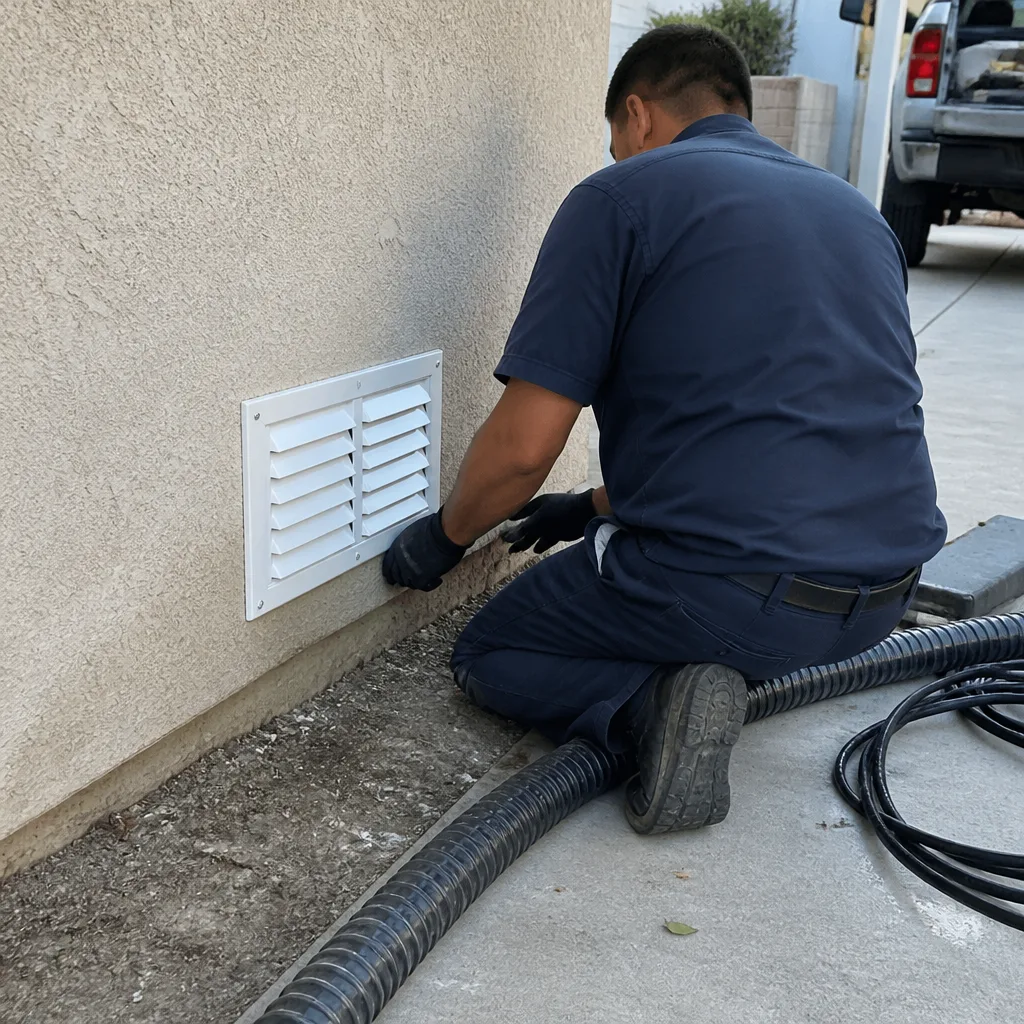
When you book with us, the process works differently. You get a written price for the entire system before any work starts, and that number doesn’t change at the door. The price is for a complete cleaning of the full vent run from dryer connection to exterior termination, using rotary brush agitation and HEPA-filtered negative-pressure extraction. You’ll also receive before-and-after photos of your own vents, so the proof is on your phone, not in a vague assurance. This is the approach that shapes everything else we do, including our Air Duct Cleaning in Woodland Hills service.
For homes where the dryer vent connects into the broader HVAC system or where you’re considering a full maintenance pass on the house, see our HVAC Cleaning in Woodland Hills page for how the two services work together and when to schedule them jointly.
How Valley Heat and Santa Ana Winds Change Your Maintenance Rhythm
Woodland Hills sits in a specific climate band where summer temperatures regularly hit triple digits, and the air during Santa Ana events is so dry that it pulls moisture from everything it touches. That has two downstream effects on your dryer. First, dryers run hotter because the ambient air entering the machine is already hot, and the humidity differential means clothes dry faster on paper, but homeowners often over-dry because the machine’s moisture sensor works differently in dry air. That over-drying runs the element longer, pushes more heat into the vent, and accelerates the bake-on of lint inside the pipe. Second, Santa Ana winds create negative pressure around the home, which can pull air back through the vent and interfere with proper exhaust flow. Dryer vents with weak flap dampers can flutter or even open in the wrong direction during high-wind events, which lets dust and debris in from the outside.
The practical adjustment for Woodland Hills homeowners is to check the vent cap more often during September, October, and November, the core Santa Ana months, and to be a little more skeptical of long drying times during summer, when a borderline vent will tip into failure faster than it would in a cooler climate-our Seasonal Air Duct Cleaning Care for Woodland Hills: Year-Round Homeowner’s Guide breaks down the full calendar. A vent that’s marginal in March can be a genuine hazard by August.
Common Mistakes to Avoid
- Skipping the lint trap because it looks clean. A lint trap that looks clean can still be coated with invisible fabric softener residue, which blocks airflow and creates a hidden layer of restriction. Run it under water; if the water beads, scrub it.
- Treating a long drying time as “just an old dryer.” In most Woodland Hills homes we’ve served, the dryer isn’t the problem. The vent is. Replacing the dryer before cleaning the vent is spending money to solve the wrong failure.
- Using a shop vac and calling it a vent cleaning. A shop vac at the dryer connection removes a fraction of the lint in a typical vent run, and it does nothing for buildup around the elbows or near the exterior termination. This is the single most common false sense of security we encounter.
- Leaving foil accordion flex duct in place. If your Woodland Hills home still has this stuff, every month it stays installed is another month of compounding fire risk. Rigid or semi-rigid metal duct is the replacement that meets code.
- Ignoring the roof vent because you can’t see it. Homes with roof-terminating dryer vents need the same attention as wall-terminating vents; in fact, they often need more attention because roof vents are longer runs with more bends. The fact that you can’t see it doesn’t mean it’s not clogged.
- Waiting for a visible problem before scheduling. By the time lint is visible at the exterior vent cap or the dryer throws an error code, the vent has been compromised for a while. The maintenance calendar is the better early-warning system.
- Hiring on price alone. The lowest bid in dryer vent cleaning is usually not a complete cleaning. If the price is under market, ask what the number covers, how many feet of vent are included, and who pays for the second visit when the first pass doesn’t clear the line.
When to Call a Professional
Call a professional when the vent run is longer than 8 feet, when it includes two or more elbows, when it exits through the roof, when you see any of the three warning signs above, or when it’s been more than a year since the last cleaning-see our guide on How to Hire a Air Duct Cleaning Contractor in Woodland Hills: A Step-by-Step Guide for what to ask. None of these situations should be handled with a homeowner-grade vacuum and a hope. The equipment required to clear a long, bend-heavy vent run and verify the job was done properly is professional-grade, and the consequences of a partial clean are the same as no clean at all. Cardinal Air Duct Woodland Hills offers free estimates in Woodland Hills. Call (559) 295-5878 and we’ll assess your vent, give you a written price before any work starts, and document everything with before-and-after photos so you can see the difference for yourself.
Frequently Asked Questions
Every 6 to 12 months, depending on your vent run. In Woodland Hills, where long vent runs and multiple elbows are common in tract homes, and where dryers run harder in valley heat, we recommend a 6-month professional cleaning for most households. A short, straight vent under 8 feet with light usage can usually go 12 months.
Expect a complete professional dryer vent cleaning for a typical Woodland Hills single-family home to run between $120 and $250. That covers the full vent run from dryer connection to exterior cap using rotary brush agitation and HEPA-filtered extraction. Get a written price for the entire system before work begins, and skip quotes structured as per-vent or per-foot teaser rates.
Cheap quotes are almost always partial cleanings. The technician advertises a low base price that covers a short section of vent, then charges extra for every additional foot, every elbow, or a second visit. A complete cleaning of a full vent run with professional-grade equipment is priced as a system, and that’s the number you should compare across companies. If one number is dramatically lower, ask what’s excluded.
Ask for before-and-after photos of your own vent interior. A Rotary brush system with a HEPA vacuum produces a visible difference, and any professional using real equipment can document it on a phone camera in seconds. If the company won’t show you the proof, you’re paying for a story, not a service. Cardinal Air Duct Woodland Hills includes before-and-after photography with every dryer vent cleaning, and you receive the images after the job.
Yes. The lint trap catches a significant amount of lint, but not all of it. Fine lint, dust, and fibers pass through the trap and accumulate in the vent run, especially around elbows and the exterior termination. The trap is your first line of defense, not your only one.
For shorter, accessible vent runs under about 8 feet with no bends, a homeowner brush kit attached to a drill can make a meaningful difference. But for the longer, elbow-heavy runs common in Woodland Hills homes, or any run that exits through the roof, those brush kits can’t reach the problem areas and may leave compacted lint in place. The hard-to-reach sections are exactly where lint poses the greatest fire risk. If your vent has any bends, hire a professional with rotary brush equipment and HEPA extraction. Call (559) 295-5878 for an exact quote, and estimates are free.
The Bottom Line
Dryer vent maintenance in Woodland Hills is a function of two variables: how your home is built and how often the dryer runs. Long vent runs with multiple elbows, common in tract homes across the valley, demand a 6-month professional cleaning cadence and a monthly homeowner inspection routine. Short runs can stretch to 12 months, but in both cases, the warning signs are predictable: longer drying times, a weak exterior flap, and a burning smell that fades fast. Catch these signals early, replace any foil accordion flex duct still in place, and you’ve removed the most preventable fire risk in your home. For a written price, before-and-after proof, and a cleaning done with rotary brush and HEPA equipment, call Cardinal Air Duct Woodland Hills at (559) 295-5878.
Written by Omar Haddad, Owner at Cardinal Air Duct Woodland Hills, serving Woodland Hills since 2005.
See the difference
 Before
 After
After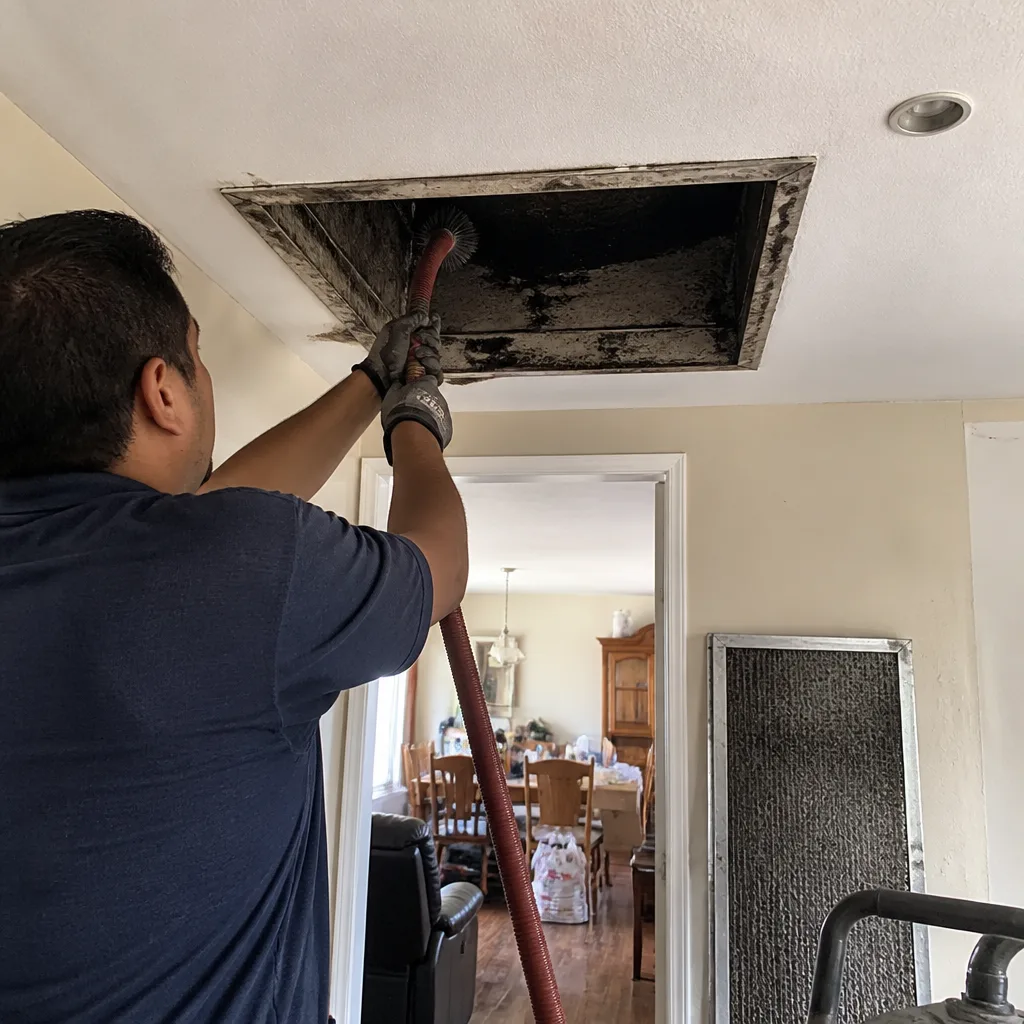 Before
 After
After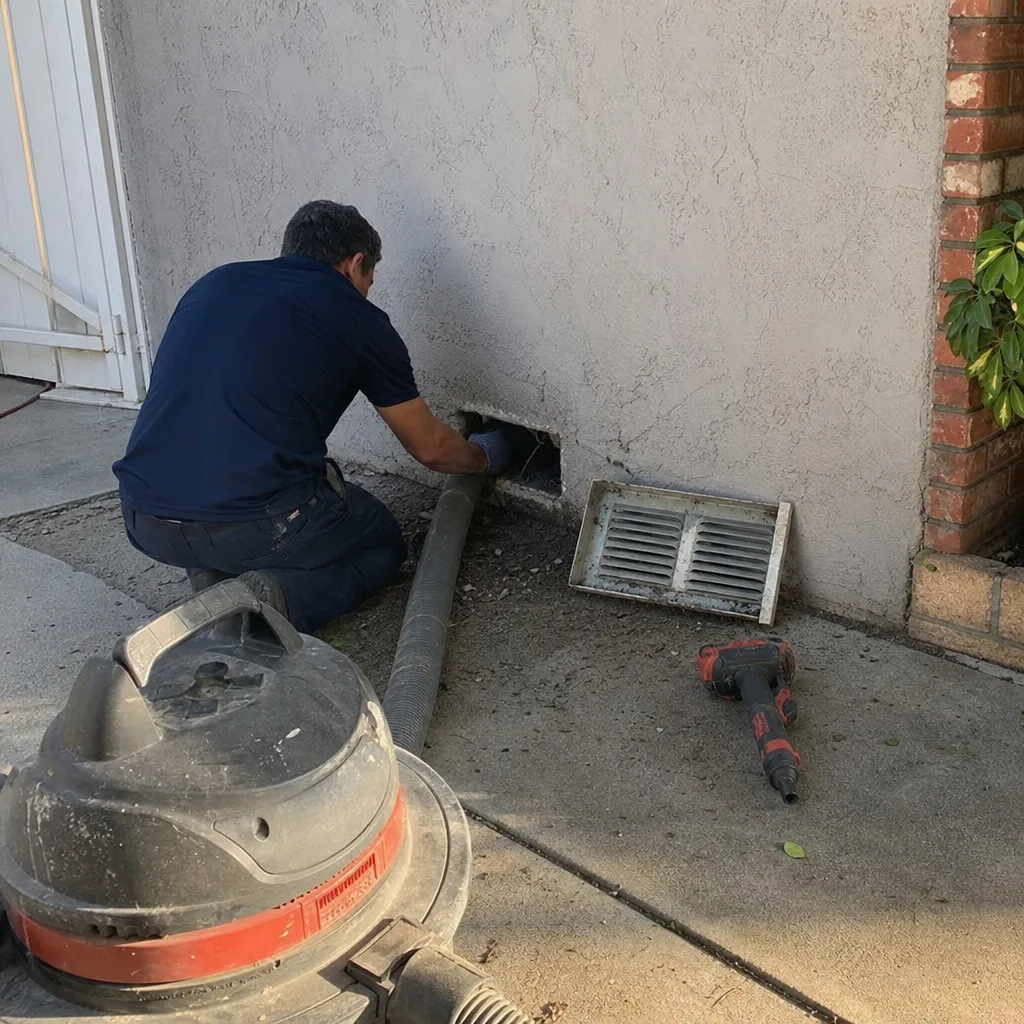 Before
 After
After